


Product Variant Management
Manage complex variants and configurations at scale.
PTC Partner Network
What is Variant Management and Why is it Important?
Product variants are modifications of a master product, such as differing feature sets, materials, colors, or performance levels. Product Variant Management is the process of managing these variations throughout the entire product lifecycle.
Mature variant management is essential for modern companies. It enables organizations to efficiently execute product platform strategies, respond quickly to “one-off” requests, reduce engineering costs, and maximize revenues by providing a diverse product portfolio that accurately meets customer needs.


Embracing Product Diversity Across the Product Lifecycle
In today’s highly competitive global marketplace, the ability to meet diverse customer preferences quickly and efficiently is key to revenue growth. While product variability offers wide-ranging benefits, it also adds significant complexity. Without the right tools, variants can complicate operational efficiency, invite errors, and increase quality costs.
Advanced PLM (and ALM) capabilities provide broad coverage for product variant management, enabling manufacturers to engineer by choice. Product geometry, embedded software, bills of information, and configurable logic can all be executed from a Single Source of Truth.
The Benefits of Product Variant Management


Greater Market Share
Product variant management is key to customer segmentation strategies that maximize market share and profitability.

Reduced Engineering Costs
Variant management maximizes the reuse of trusted engineering artifacts throughout the product lifecycle, lowering overall engineering costs.

Strategic Flexibility
The ability to quickly swap in lower-cost materials, rapidly create a customer special, or respond promptly to competitive threats requires advanced variant management capabilities.

Improved Product Quality
Variant management enables organizations to focus their quality processes on shared parts and platforms, reducing the overall cost of delivering high-quality products.

Faster Time to Market
Maximize reuse and bring new products to market in a fraction of the time otherwise required.

Grow Market Share with Product Variant Management to Meet Customer Needs
Traditional approaches to manufacturing make the production of variants and configurations increasingly complex. Product diversity can breed increased inventories, reduced economies of scale, service inefficiencies, manufacturing errors, and an increased risk of non-compliance.
With PTC’s Product Variant Management solution, time-to-market is dramatically reduced as developers leverage design reuse. Manufacturing performance becomes seamless through configuration-specific process plans and work instructions. Furthermore, first-time fix rates increase as engineering provides product-specific data to field technicians.
Taken together, PTC’s product variant management capabilities enable manufacturers to efficiently pursue new market opportunities while lowering overall lifecycle costs.
PTC Partner Network
Managing Controls, Platform Modules, and Configurations
Platform strategies begin once a decision is made to define products in a new or different way. They are built from a base product platform containing the key features and functionality common to all planned variants.
With PTC’s product variant management, you can strategically design, create, manage, and validate product variants. Platform options, choices, logic, and configuration rules are directly linked to the Bill of Materials (BOM), 3D visualization, and CAD data to deliver a robust modular solution. Platform information can be fully lifecycle-managed, making it easy to validate products and share data with other enterprise tools such as ERP and CPQ.


Key Product Features
Windchill offers comprehensive and native (ready-to-use) configuration management for a model-based Digital Thread. All digital content for subsequent processes is associative, and not merely copied, ensuring traceable and up-to-date links for manufacturing, services, and related areas.
Option Pool/Option Set
Provide enterprise management and visibility to options and logic, removing the reliance on disconnected spreadsheets.
Advanced Logic
Handle complex variable logic for Configure-to-Order needs using range-based variables, case tables, and advanced expressions.
Product Family Matrix
Quickly visualize how configurations are planned and make updates to the product portfolio as needed.
Independent Assigned Expressions
Update customer offerings without requiring engineering to perform logic-only updates to the BOMs.
Rules Logic
Build logic containing diverse rules that define product configurability. Seamlessly bridge the gap between engineering requirements and marketing logic.
Multiple Development Streams
Manage parallel development branches with full control over merged changes to maintain superior product quality.
Change Management
Synchronize changes from design to plant-specific production data in ERP systems, with both local and global rule effectivity management.
Configure Variant BOM
Generate configurations for order-specific variants or define stock offerings derived from a common product platform.
Related Capabilities


Bill of Materials (BOM)
Capture, configure, and manage all product data developed throughout the lifecycle. Unify engineering, manufacturing, sales, and service teams with a Single Source of Truth for product structures and parts.


Configuration Management
Manage product complexity with knowledge-based configuration of parts and components. Address customization requirements with efficient Configure-to-Order (CTO) and Engineer-to-Order (ETO) lifecycle processes.


Change Management
Effectively control and govern product changes. Accelerate delivery using repeatable, automated workflows to manage engineering and process changes.
Case Studies: How Industry Peers Leverage Variant Management
See how leading global manufacturers utilize PTC’s PLM to manage product complexity and scale their operations efficiently:
Volvo Group | Tackling Product Complexity with Platform Architectures
Discover how Volvo Group leverages Windchill to address industry challenges using a modular approach to product development.
Groupe Beneteau | Engineering for Choice
See how Groupe Beneteau uses product variant management to enable mass customization of its boats, resulting in an increased market share.
Volvo CE | Unifying Global Development Efforts
Read how Volvo CE enabled enterprise collaboration across 5 distinct product lines, 270 models, 18,000+ options, and 11 factories worldwide.
Tools for Product Variant Management
Today, a product variant not only changes the engine or the physical casing (managed by Windchill); it also changes the firmware or the embedded system screens (managed by Codebeamer). The integration between these two solutions ensures that, when selecting a hardware variant, the correct corresponding software is automatically associated and validated.


Codebeamer (ALM)
Codebeamer is a next-generation ALM platform built for advanced product and embedded software development. This open platform extends traditional ALM functionalities with robust product line configuration capabilities, providing unique configurability and compliance management for complex, software-driven engineering processes.

Windchill (PLM)
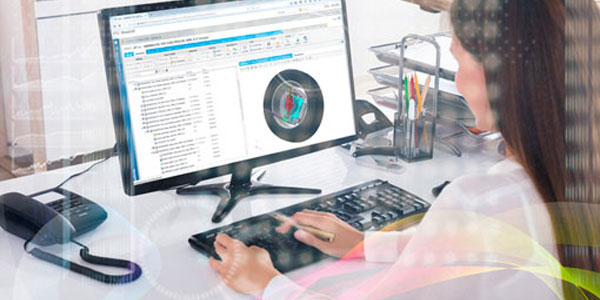
Windchill is an industry-leading PLM solution designed to drive enterprise-wide operational efficiency. Deployed worldwide, this comprehensive platform empowers more than 1.5 million users to connect with their organization's digital thread. See how Windchill transforms the way global teams manage product variability at scale to seamlessly customize multiple product lines.