


CAEfatigue: Fatigue & Durability Analysis
Perform accurate fatigue analysis with Hexagon’s CAEfatigue and OMC GROUP. Improve product durability, cut testing time, and optimize designs with simulation tools.
HEXAGON
CAEFatigue (CF) is the fastest and most robust fatigue solution on the market today
CAEfatigue is a random response and vibration fatigue solver for the frequency domain plus a fatigue solver for the time domain. It works with mixed random and deterministic loadings or standard time domain-based loadings to provide fatigue life and damage predictions, as well as several forms of response statistics. It is exceptionally fast, easy-to-use and capable of handling very large models.
The software also offers tools for loads management including digital signal processing, as well as a Robust Design feature that allow users to analyze the robustness of their FEA models to variations in FEA solution parameters.
The software is available in 4 different package configurations – Premium, Frequency, Random, and Time. Click the tabs below to learn more about each specific solution.
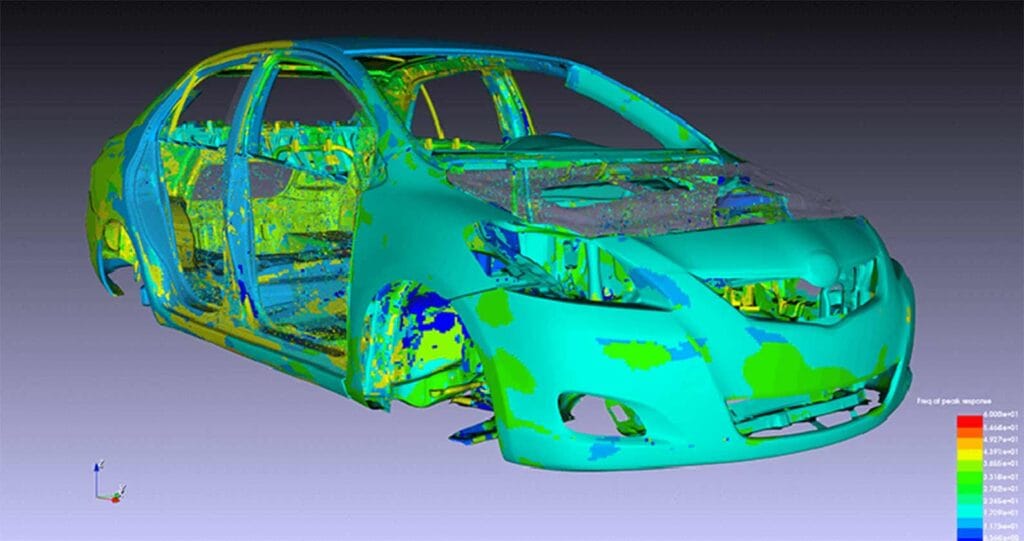
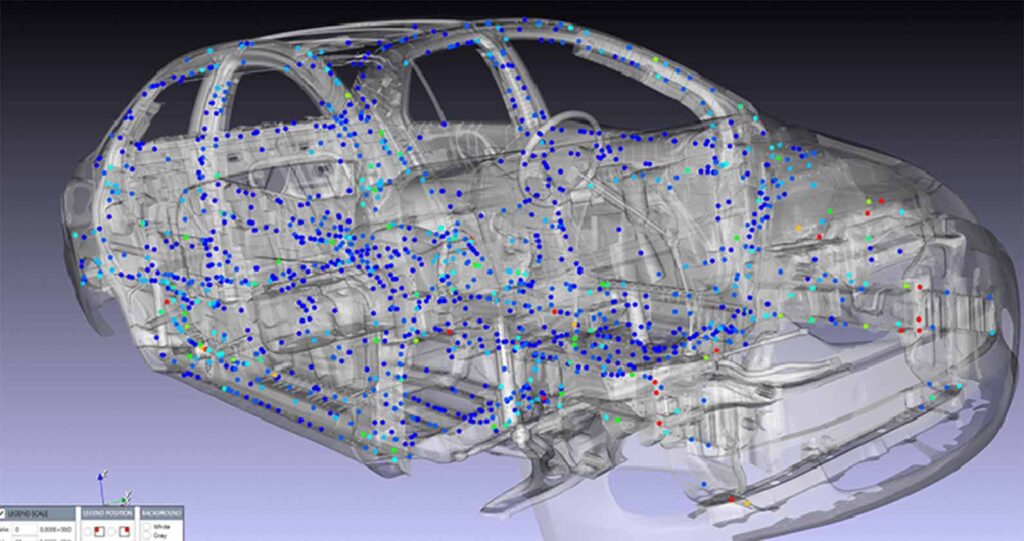
Spot and seam weld fatigue analysis is critical to automobile durability. Learn how Ford Motor Company applied a new approach
Ford Motor Company
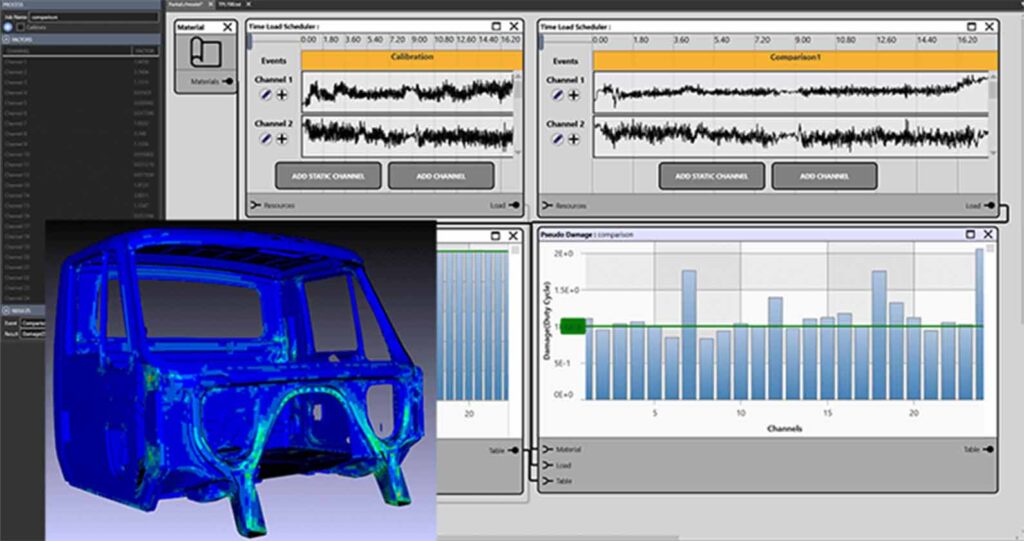
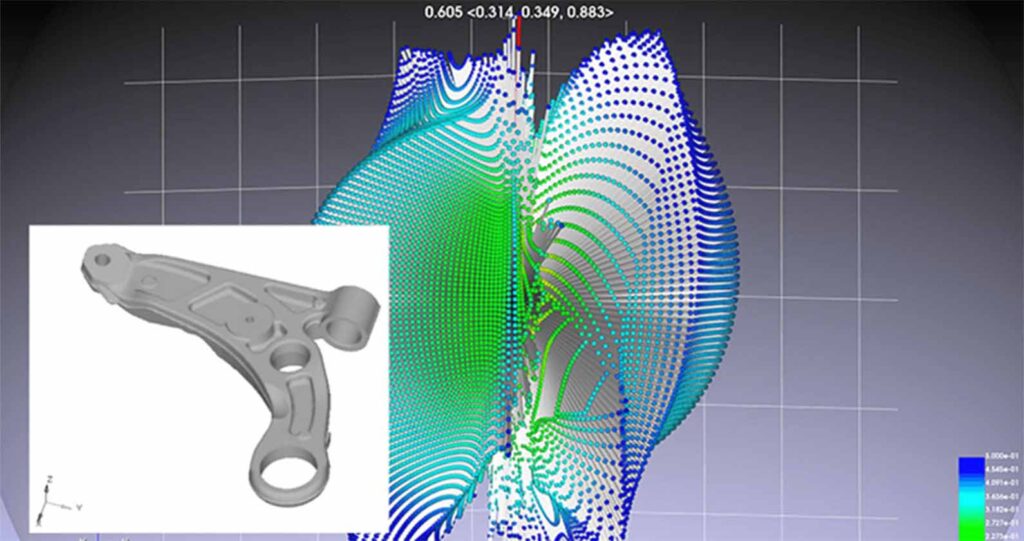
A simplified duty cycle on the lower control arm, resulting in a better long-term design.
Fiat Chrysler Automobiles
HEXAGON
Democratizing fatigue analysis for the masses
Response analysis, fatigue analysis, and the use of a graphical interface have traditionally suffered from a lack of democratization; that is to say, only expert users have been fully capably of using the technology. CAEfatigue aims to change this.
Two interfaces to the software are available – a Control File, text-based interface is provided for the advanced Users to help rapidly create an input control file that is needed to run an analysis. Many variables are either used in default mode or are automatically calculated based on an understanding of the system being analyzed.
Also available is a Process Flow graphical-based interface, provided to help novice users quickly gain an understanding of the technology without the need to understand the structured format of the control file interface. The interface is simple and intuitive to use.
Included in your MSC One licensing package
If you have the MSC One licensing package, you already have access to CAEfatigue’s suite of capabilities. Frequency, Random and Time are all available via MSC One. Simply download the software, follow the built-in video training tutorials, and begin your fatigue simulation using the same tokens you use for other Hexagon tools.
Why choose CAEFatigue over other frequency domain competitor tools?
- CF processes models from multiple sources including MSC Nastran, NX Nastran, Abaqus, Ansys and Optistruct.
- CF processes very large models (Tb+) with little difficulty.
- CF allows the use of unlimited multiple correlated inputs and includes accurate calculation of the cross-correlation influences between inputs.
- CF allows the inputs to be mixed loading (e.g. sine sweep, sine-on-random PSD, consecutive sines, etc. plus a mean (static) loading).
- CF provides advanced equivalent stress modelling (e.g. complex von-Mises, complex Principal, etc.).
- CF uses Running Sum Technology that allows for very fast analysis.
- CF is so fast that the User can do Design Of Experiments by running hundreds of jobs in quick succession.
- CF allows the use of typical automotive materials (e.g. Strain-Life and Stress-Life) and mean stress corrections in the same analysis.
- CF will produce both random response statistics and fatigue results in a single executed analysis.
- CF is a Custom Driven Technology. We strive to adjust our strategic development planning to match the needs/desires of our Customers. Tell us what you need and we will strive to make it happen!
HEXAGON
Additional features and capabilities:
Running Sum Technology allows the analysis to run orders of magnitude faster then 1st generation tools.
Multi Input Loading allows multiple, correlated, or uncorrelated input loads for real world simulation.
Easy Adoption for users through a simple GUI or operation from a command prompt.
Multiple Output Options provides information on response stresses, damage and fatigue life results.
Remote Installation makes integration easier for larger companies.
Very Large Models can be evaluated using our running sum technology.
Sine Sweep (SINESW) enhancement now supports mixed loading units.
SN/EN Material Property can be provided in many different formats for your analysis.
Equivalent Stress Correction options including Critical Plane, provides the ability to do more accurate equivalent stress corrections.
Mean Stress Correction provides the ability to do mean stress corrections as part of the analysis.
Plasticity Index is a non-linear response statistic output.
Damage Sensitivity analysis can help optimize the design and materials used to save cost and weight.
Frequency of Response provides the ability to see a fringe plot of frequency values at peak response.
Random Response provides displacement, velocity, acceleration and force output.
Event Repeats allows you to specify repeats of loading Events for Damage Calculations.
Response Notch allows partial scaling of the transfer function for “what if” Damage Calculations.
Hotspot / Filter capabilities offer the ability to quickly filter the analysis allowing the processing time to be vastly reduced.
Collision Detection allows the relative comparison of displacement responses to determine if parts, which are separated by a design gap, lose that gap under the random and/or deterministic input loading.
Spot / Seam / User Welds add capabilities for doing spot weld, seam weld (2D and 3D) and BS7608 weld analysis in the time domain as well as an industry first, doing spot weld, seam weld (2D) and User weld analysis in the frequency domain.
Factor of Safety provide a comparative evaluation of the fatigue life results against a desired life result.
Multi Axial Assessment allows the user to evaluate the stress state of their model. This evaluation will help determine which equivalent stress option to use.
Pseudo Damage allows the user to compare baseline and design change time history results as if those results caused damage, even though an FEA model or actual stress results are not available.
Rainflow Cycle Counting provides output plots of rainflow cycle data for both a time domain and frequency domain analysis.
Digital Signal Processing allow modification and export of time signals through a formula-based interface.
Robust Design allows the solver / CAEfatigue analysis to be rerun in order to analyze the robustness of the nominal parameters used in the solver and CAEfatigue runs
