


PTC CREO: 3D CAD Software for Product Design and Engineering
Master 3D parametric engineering with PTC Creo through OMC GROUP and slash time-to-market.
PTC Partner Network
What is PTC CREO? The Unified 3D Parametric CAD Platform.
PTC CREO is a leading parametric solution that eliminates fragmented workflows by centering the entire development cycle around a single, fully associative digital model. Unlike tools that rely on disconnected add-ons, any design modification automatically propagates downstream to analysis and production teams, completely removing manual rework. The platform seamlessly combines robust modeling with real-time simulation, model-based definition (MBD), and advanced subtractive and additive manufacturing. Available both on-premises (Creo) and as a cloud-native SaaS offering (Creo+), it provides total licensing flexibility and real-time collaboration.
O Poder do CAD 3D Paramétrico na Prática
Reduce time-to-market by up to 57% with native integration across CAD, PLM, and ALM.
From Concept to Manufacturing
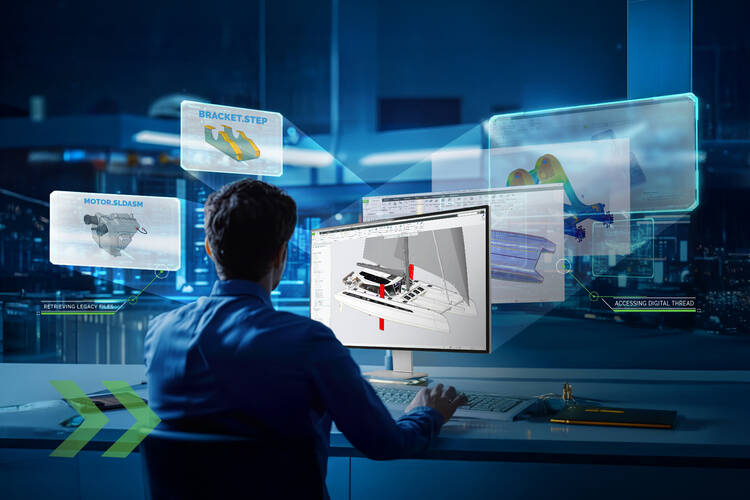
PTC CREO unifies concept engineering, detailed mechanical design, and real-time simulations. Any change to the design automatically updates technical drawings and production downstream. This eliminates manual rework, cuts design time by 30%, and speeds up product launches by 57%.

Connected Manufacturing
PTC CREO links product design directly to production by integrating high-speed CNC machining, mold, and die design. Because every stage stays synchronized with the original 3D model, modifications update automatically, eliminating handoff errors and reducing manufacturing scrap.
What are the benefits of Creo?
Creo is a fully integrated 3D CAD solution that enables engineers to seamlessly conceptualize, design, analyze, and validate products. It provides technologies that empower design engineers to simulate and optimize products for weight, performance, cost, and sustainability, using a wide range of materials and manufacturing processes.
These benefits go beyond the engineering department. With a model-based approach, 2D drawings can be replaced by fully annotated 3D models, streamlining the manufacturing, inspection, and maintenance of parts and assemblies.

Lower Operational Costs
Utilizing 3D parametric models to refine designs prior to production drastically reduces errors and late-stage engineering changes. This approach effectively lowers manufacturing cost.

Faster Design Cycles
Build better products faster. Validating design quality early in the development lifecycle and embedding 3D annotations streamlines downstream manufacturing activities.

Higher Performance
Differentiate your products with exceptional field performance. Optimize your structural designs for weight reduction, reliability, sustainability, and advanced additive processes.

Fewer Physical Prototypes
Integrated real-time simulation tools allow engineers to predict design responses to real-world conditions, saving critical development time and prototyping costs.

Efficient Reuse
Parametric models and user-defined feature presets capture the original design intent, enabling seamless reuse of parts and complex assemblies without duplicating effort.

High First-Pass Success
Connecting 3D designs directly to manufacturing workflows ensures models are production-ready, reducing shop floor issues and increasing first-pass success rates.
Creo Buying Options | Activate the Industry-Leading 3D CAD Tool
From enterprise licensing for large industries to single licensing for smaller teams, we make it easy to access and activate Creo: the professional’s choice for parametric engineering and design. Find the ideal model below to drive operational efficiency and high performance across your projects.
Creo for Solo Designers
Full Power in One System
Complete solution to model, simulate, and manufacture innovative ideas.
Streamlined workflows to keep schedules on track without compromise.
Automatic conversion of 2D drawings into fully parametric 3D models.
Creo for Small Group
Efficient and Agile Collaboration
Advanced 3D design software capabilities customized for up to 5 user licenses.
Industry-proven software stability for complex parts and massive assemblies.
Integrated finite element structural, thermal, and dynamic motion analysis.
Creo for Growing Teams
End-to-End Scalable Architecture
Full support from concept to manufacturing for 5 or more licenses.
Accelerated time-to-market driven by Artificial Intelligence enhancements.
Flexible licensing on a single platform to match your operational demands.
PTC Creo Features and Innovations
Seamlessly integrated into the Digital Thread and backed by OMC GROUP’s consultive engineering, the Creo ecosystem enables the complete unification of concept engineering, real-time simulation, and advanced manufacturing. This structured approach eliminates operational silos, slashes design time by up to 30%, and accelerates overall time-to-market by 57%.
AI-Driven Generative Design
Creo generative design leverages advanced algorithms to produce optimized components based on real-world load and manufacturing constraints. It boosts engineering productivity and slashes time-to-market, delivering lighter and stronger parts.
Explore Generative Design
Ai-Driven CAM Tools
Creo’s CAM tools streamline CNC programming, toolpath optimization, and mold validation workflows. High-speed milling extensions stay fully associative to the original 3D CAD model, ensuring production efficiency and maximum part quality. Enjoy robust workflows.
Explore Cam Tools
Additive Manufacturing
Creo simplifies additive manufacturing by removing the need for multiple disconnected software packages, eliminating time-consuming translation errors. Easily create complex lattice structures and connect to industrial 3D printers to reduce production costs and expenses.
Explore Additive Manufacturing
CAE Simulation and Analysis
The suite supports multiple analysis levels: from instantaneous structural, thermal, modal, and fluid feedback via Creo Simulation Live to high-fidelity validation with automated meshing via Creo Ansys Simulation. Run validation earlier to design better products faster.
Explore CAE Solutions
Composite Design
Efficiently design, simulate, and manufacture composite parts with scalable tools that generate accurate solid geometry from composite layers. Merge plies from different zones to expand conceptual design capabilities and enhance structural robustness. Advanced features.
Explore Composite Design
Model-Based Definition
BD eliminates redundant 2D drawings by embedding all product and manufacturing information (PMI) directly into the 3D model. This drives engineering activities from a single source of truth, preventing handoff errors between teams, suppliers, and partners. Streamline paths.
Explore MBD Solution
Artificial Intelligence (AI)
AI-driven tools in Creo augment traditional engineering methodologies to drive innovative, precise design. By automating repetitive workflows and offering data-driven material optimization recommendations, AI provides real-time insights to accelerate productivity.
Explore Creo AI
Check our CAD Capabilities
Creo provides a solid foundation of CAD capabilities to meet a wide variety of engineering needs. OMC GROUP offers several CAD packages and numerous extensions to meet your specific design requirements. Explore our capabilities.
Creo for Every Role in Product Development
Discover how PTC Creo addresses the specific needs of every professional across the product development lifecycle. Mechanical design engineers benefit from robust parametric and direct modeling in a single environment, while manufacturing teams leverage fully integrated CAM tools associative to the original CAD model to eliminate technical handoff errors.
Advanced Modeling and High Performance
PTC Creo delivers best-in-class tools to engineer complex parts and massive assemblies with absolute confidence. Design teams leverage advanced aesthetic surfacing (Class A), sheet metal design, composite structures, and Model-Based Definition (MBD) assistance, preserving the original design intent throughout its evolution.
Connected and Error-Free Manufacturing
The suite eliminates translation errors by unifier-integrating high-speed CNC machining, mold and die tooling, and industrial metal additive manufacturing directly to the original associative CAD model. Engineering changes automatically propagate downstream, completely removing handoff errors and lowering manufacturing scrap.
Real-Time Virtual Validation
Utilizing integrated high-speed solvers, the platform executes robust structural (linear and non-linear), thermal, modal, and computational fluid dynamics (CFD) analysis. This instantaneous feedback allows engineers to predict product response under real-world conditions, validating design decisions prior to building physical prototypes.
IT Governance and Infrastructure Efficiency
Centralizing design, simulation, and manufacturing into a single system radically streamlines software license management. Operating with a fully associative digital model eliminates time wasted on file conversions, workarounds, and fragmented third-party add-ons, ensuring corporate scalability backed by TISAX automotive security standards.
Digital Thread and ROI Maximization
Creo establishes the complete Digital Thread by connecting product lifecycle data directly to advanced manufacturing and testing, cutting time-to-market by up to 57%. This unified technical visibility minimizes operational costs, optimizes inventory via industrial AI, and sharpens business competitiveness on a global scale.
Frequently asked questions
What companies use Creo?
Creo has a wide variety of customers, from start-ups to Fortune 500 corporations. A truly global company, we have customers with operations on every continent and representation in nearly every major industry.
What is Pro/ENGINEER?
Pro/ENGINEER (Pro/E) was PTC’s original CAD solution. Pro/E was the industry’s first parametric, feature-based solid modeling CAD software, meaning that an adjustment to a single parameter would automatically update the rest of the model. Pro/E was named Technology of the Year by Industry Week in 1992.
In 2010, Pro/E was renamed Creo. Each year PTC continues to expand its capabilities in Creo and invests in improvements to make everyday engineering more productive, as well as introduce cutting-edge manufacturing, generative design, AI, and simulation technologies.
Is Creo easy to learn?
PTC has invested millions of development dollars and thousands of development hours to improve the usability of Creo. The result is an intuitive CAD solution that is both powerful and easy to learn.
PTC University provides the best-in-class, instructor-led and self-paced training courses for Creo. PTC University offers unlimited virtual instructor-led classes for one low cost.
How is Creo better than other CAD systems?
There are many CAD solutions available, but none of them match up to the combined benefits of Creo:
- Parametric: PTC was the innovator of parametric modeling, and we continue to lead the way with Creo. Parametric modeling captures the design intent, not just the dimensions. When a part is changed, perhaps years later by another engineer, the original design intent is maintained, helping to ensure a quality design.
- Integrated: Many competitive CAD systems are challenged when a part design is exported to a third-party software and then reimported. With Creo, there are so many deeply integrated design capabilities that the 3D model can be maintained throughout the design process and beyond. With Creo, the design intent and integrity of your model is maintained.
- Powerful: Creo is recognized as a technology leader. A powerhouse in the world of model-based definition (MBD), Creo is award-winning for breakthroughs in generative design, real-time simulation, and additive manufacturing, to name a few. You may not use all of these technologies today, but Creo has them available when you need them.
- Easy to use: PTC has invested millions of development dollars and thousands of development hours to make Creo intuitive and easy to use. PTC University offers best-in-class live and virtual, instructor-led and self-paced training courses for Creo, including certification courses and an innovative subscription-based service with unlimited virtual, instructor-led classes.
- Scalable: Creo is competitively priced for start-ups through major enterprises. And unlike other CAD systems that have distinct CAD systems for different types of customers, Creo companies, customers, and suppliers of all sizes can share data files effortlessly.
- The PTC family of products: Creo seamlessly integrates with PTC’s suite of market-leading industrial software solutions like Windchill PLM, ThingWorx IoT, and Vuforia AR, just to name a few.
If you’re looking for the best in CAD solutions, you search starts and ends with Creo.
What are the benefits of using AI and CAD?
AI-driven tools, like those in PTC‘s Creo, can automate repetitive tasks, optimize designs, and predict potential issues. The integration of AI with CAD can help engineers create superior products faster.
Talk to a CAD Expert
Best-in-Class Organizations Need a Best-in-Class CAD Solution
Give stakeholders throughout your engineering workflows quick and precise access to product geometric data. PTC Creo, the robust 3D parametric CAD platform deployed by OMC GROUP, breaks down operational silos and drives the Digital Thread, leading to:
- Improved Time-to-Market: Achieve up to a 30% reduction in design time and a 57% faster time-to-market.
- Decreased Costs: Completely eliminate downstream engineering rework and minimize material scrap on the shop floor.
- Enhanced Product Quality: Ensure structural integrity and strict dimensional compliance using built-in GD&T standards.
- More Time for Innovating: Leverage AI-driven modeling and generative design features to accelerate complex engineering programs.
Creo delivers the raw computational performance and enterprise scale required to seamlessly manage massive industrial datasets.
Ready to learn more about what advanced CAD solutions can do for you? Submit the form and let’s start a technical conversation.

